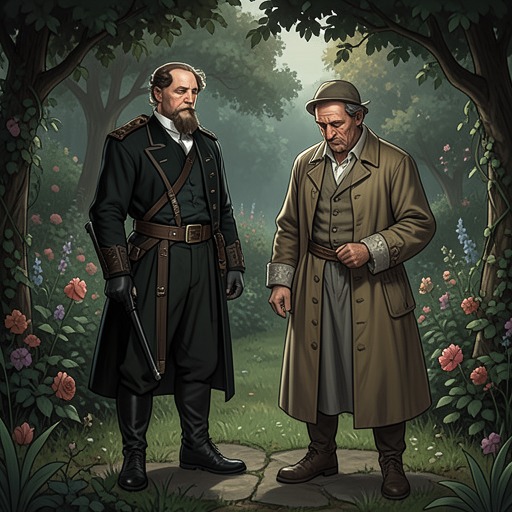
Mary Datchet and Ralph Denham
Night and DayMary Datchet and Ralph Denham share a friendship of unusual intimacy, but its emotional currents do not run in parallel. Mary comes to love Ralph and recognizes that he does not love her in return; Ralph, for his part, values her and eventually asks her to marry him, yet his own account of his feelings reveals how deeply his romantic imagination has been occupied by Katharine Hilbery. Their bond is therefore neither simple indifference nor a fulfilled romance: it is a relationship in which companionship, misreading, honesty, and restraint repeatedly bring them close without making their desires coincide.
Friendship and the Shape of Intimacy
Ralph is methodical about his life and expenditure, and ordinarily separates work from personal attachment. His young male colleagues remain in the compartment of life devoted to work. Mary unsettles that order. Their acquaintance begins with her laughing at one of his remarks; she finds him astonishingly odd, and her amusement grows as she learns the patterned detail of his days. Ralph tells her how he spends Mondays, Wednesdays, and Saturdays. She takes an interest in his knowledge of bulldogs, his collection of wild flowers found near London, his weekly visits to Miss Trotter at Ealing to discuss heraldry, and their summer excursions to nearby churches to make rubbings of monumental brasses. Within six months, Mary knows more about these habits and his unusual circle of friends than his brothers and sisters do. Ralph, whose self-conception is profoundly serious, finds her attention pleasant even as it disorders his settled picture of himself.
That closeness does not erase his reserve. Ralph automatically divides his thoughts into those he can discuss with Mary and those he keeps to himself. Mary notices the distinction. Unlike her usual encounters with young men, in which she listens to them with something like maternal patience, her friendship with Ralph leaves her with a keener awareness of her own individuality. Their intimacy gives Mary a space in which she is not simply a listener to a man's self-description, but it remains bounded by what Ralph will not share.
Divergent Feelings and Misread Silence
When Ralph visits Mary unexpectedly, she is cleaning knives in her small scullery. She turns on the cold-water tap and shuts it off again, trying to prevent her feelings from taking hold of her attention. She then calls into the sitting room with a question about Mr. Asquith and begins discussing the Government's latest evasion concerning the Women's Suffrage Bill. Ralph would rather not discuss politics, but respects her serious engagement with public questions. As they consider what women should do, Mary wants to move toward something personal and discover what he feels for her. She resists that impulse; meanwhile, Ralph's thoughts turn toward Katharine and the romance and adventure he associates with her. He feels sorry that Mary cannot know what is occupying him, yet mistakes the distance between their feelings for a difference between women and men in their capacity for romance.
The scene makes their emotional mismatch a matter of form as well as content: each has thoughts about their relationship, but neither opens the conversation that might bring those thoughts into contact. Ralph's silence seems to Mary to concern the very subject she is trying not to raise. She imagines their thoughts as parallel tunnels that approach one another without meeting. When he leaves after offering little more than the words needed to say good night, Mary reviews her feelings rather than treating love as necessarily overwhelming or self-erasing. Her reflection becomes part of a continuing effort to understand her attachment and judge what it asks of her.
Mary's feelings become unmistakable after a day that includes a gathering and a walk with Ralph. Though she means to spend time alone and think through her position, the streets continually divert her attention: the vision of humanity associated with Bloomsbury fades as she crosses the main road; an organ-grinder in Holborn interrupts her thoughts; and, in Lincoln's Inn Fields, darkness leaves her cold and suddenly clear-sighted. A tear falls as she realizes that she loves Ralph and that he does not love her. The empty path where they walked and the silent sparrows in the bare trees give physical form to that discovery, while the lights in her own building restore some comfort. She postpones a fuller reckoning until Christmas, telling herself that London makes clear thought impossible and imagining that she may take long walks in the country.
The Proposal and Mary's Refusal
Ralph's eventual proposal grows out of a moment that he himself does not understand as a settled plan. In Lincoln, while Mary describes people visible from a window, Ralph has been building a jumble of thoughts from local conversation and his own associations: duck shooting, legal history, the Roman occupation of Lincoln, and the relations between country gentlemen and their wives. Out of this disjointed mental accumulation comes the idea that he should ask Mary to marry him. It feels spontaneous and new, and for a moment he nearly voices it at once. His habit of sorting thoughts before speaking holds him back; watching Mary, he is moved by a wish for her tenderness and comfort. He begins by apologizing, urged by an instinct to make an irrevocable commitment before their moment of intimacy passes.
But Mary's answer is no. On the return journey, Ralph scrutinizes his recent meeting with Katharine, trying not to let its glow and romance distort what he should regard as fact. Mary is silent, and he understands that she cannot accept his proposal. He then tells himself that he had always been thinking of Katharine while with Mary, and that his own moods may have cost him an earlier chance with her. His despairing assessment of his life shows how suddenly the proposal has exposed a loss he had not faced directly. To Mary, the proposal confirms rather than repairs the imbalance: she believes that Ralph does not love her, and that he has not truly meant what he said.
Mary does not answer by surrendering to the affection that remains. She is tempted to trust him and tell him how her feelings have changed, but his words reinforce her conviction that he does not love her. She regards it as degrading to abandon her judgment to emotion, even when emotion is powerful; her silence is a refusal to pretend that the central difficulty has disappeared. When she explains herself, she distinguishes ordinary inaccuracies from a deeper failure of truth. She says she could not care for someone who lied in that consequential sense, and that truth matters to her, though not in the same way it matters to Ralph. She is surprised by her own use of the word love, but forces herself to finish what she means.
Ralph does not press her to marry him. He questions the certainty and practical wisdom of romantic love, describing it as a story people compose about another person and preserve by limiting how often they see each other or spend time alone together. He considers marriage to someone one is in love with a great risk. Mary nonetheless agrees that they can remain friends and says she will continue seeing him. Her decision preserves the relationship while refusing to let friendship disguise the truth of the rejected proposal. She later reiterates that she is not angry and will go on seeing him, even as she identifies his apparent lack of sincerity as what made her angry at the time.
Friendship After Rejection
Their friendship continues to provide Ralph with sympathy, but it does not make Mary responsible for curing his unhappiness. At one point she asks whether he looks unhappy and whether something is wrong. They walk around the Fields discussing chronic difficulties in the Denham family. These are problems that can, at least in principle, be addressed; talking them through soothes Ralph, while the melancholy whose real cause cannot be treated in that way recedes from his immediate attention. The episode shows both Mary's practical care and the limit of that care: she can help him dwell on solvable troubles, but cannot resolve his attachment to Katharine or the history of their unreciprocated feelings simply by listening.
Later, when Ralph abruptly says that he has been thinking of Mary and asks whether Katharine would mind going with him to Mary's rooms, the old connection briefly returns to the foreground. Katharine agrees, and Ralph crosses the road and goes up the steps to Mary's house. He cannot bring himself to knock. He waits outside, unable to speak, and later tells Katharine he did not go in because he could not make himself do so. The failed visit marks a final hesitation in a relationship already defined by what remains unspoken: even when Ralph seeks Mary, he does not complete the act of contact.
Change and Significance
Mary's attachment is not static. When she tries to recall the former intensity of her love, she finds that the image of Ralph once surrounded by an exhilarating haze has become difficult to recover. The pain of loss remains, and she believes that neither success nor happiness nor oblivion could make up for it. Yet she also recognizes that she now knows the truth. In a sudden realization, the old love seems to have given way to another; she says that there are different ways of loving. This change does not erase what she once felt or make the earlier rejection painless. It alters her understanding of herself and her attachment, allowing her to see that the love she had organized around Ralph is no longer the same.
The relationship's importance lies in how it separates emotional care from romantic reciprocity. Mary pays sustained attention to Ralph's habits, listens to his concerns, and offers companionship; Ralph values that attention but repeatedly keeps his innermost thoughts apart from her, particularly when they concern Katharine. His proposal cannot retroactively make their desires equal, and Mary's refusal is grounded not only in the fact that she has been hurt but in her insistence that an intimate commitment must be truthful. Their continuing friendship, her later recognition that her love has changed, and Ralph's inability to knock at her door leave the relationship unresolved as romance but sharply defined as an experience of affection, discernment, and limits.